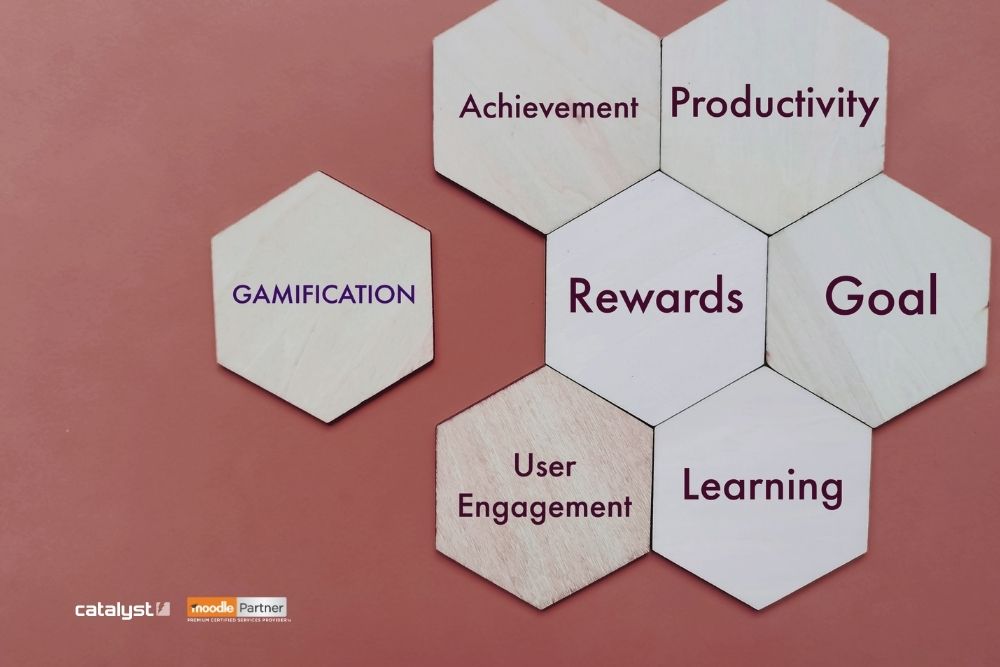
At its core, gamification is applied by using in-game mechanics, such as points, badges, levels, leaderboards, and challenges, and applying them to environments that have an objective and require someone to progress towards a certain level.
Some gamified elements that can be added into your Moodle LMS content include:
- Points to show progression or improvement
- Badges and prizes which can showcase achievements by reaching or completing a task or objective set by the instructors/course administrator.
- Leaderboards tailored to whichever competency you wish to reflect. For example, you can use a leaderboard to show the week’s best performers.
- Progress bars to help visualize how learners are progressing, such as how much course content they have covered.
These are just some gamification features you can implement in your Moodle LMS. With Moodle’s flexibility, gamification is another way to customize your Moodle environment and adapt your LMS to your teaching strategies, rather than the other way around.
Benefits of Gamification in Learning
Gamification is not about turning your course into a video game, or slapping a badge icon onto an existing quiz. When done well, gamification can cater to different learning styles, improve learning experiences, and increase engagement and participation amongst learners. Here are some of the benefits of gamification when implemented properly on your Moodle LMS:
- Instant feedback. Quizzes, interactive simulations, and point systems give learners immediate confirmation of whether they’re on the right track, rather than waiting days for a grade. With instant feedback, mistakes get addressed while they’re still fresh.
- Active participation. Gamified activities often ask learners to apply concepts, rather than just read about them, which helps deepen understanding and improve how well the material is retained.
- Visible progress. Elements like progress bars make otherwise invisible learning visible, for both the learner and the instructor.
- A lower-stakes environment for mistakes. When learning is framed as a game, making errors feel like a part of the process instead of a penalty, which can make learners more willing to experiment and try again.
In contexts of workplace training and professional development, gamified mechanics can translate into a slightly different set of benefits:
- Quantified growth. Gamified training can make it easier for employees to spot their own skills gaps and track how they’re developing over time, rather than growth staying unmeasured.
- Meaningful rewards. Built-in rewards increase the odds that training actually gets recalled and applied back on the job, and can make the learning process itself feel less like a chore and more like a break from day-to-day stress.
- Friendly competition. Leaderboard-style, points-based elements can add a layer of light competition that can nudge engagement and productivity upward.
- Structured for distributed and evolving teams. Gamification gives remote employees or employees in different time zones a shared, structured way to stay engaged with training without needing to be in the same room.
Considerations for gamification in professional development
If you were at MoodleMoot Canada 2026 in Montreal, you would have heard from Emilie Ringuet (Conseillère en pedagogie et technopedagogie, Université du Québec à Rimouski) about how she and her team used play-based strategies with festive, holiday-themed content to conduct professional development training for their teachers.
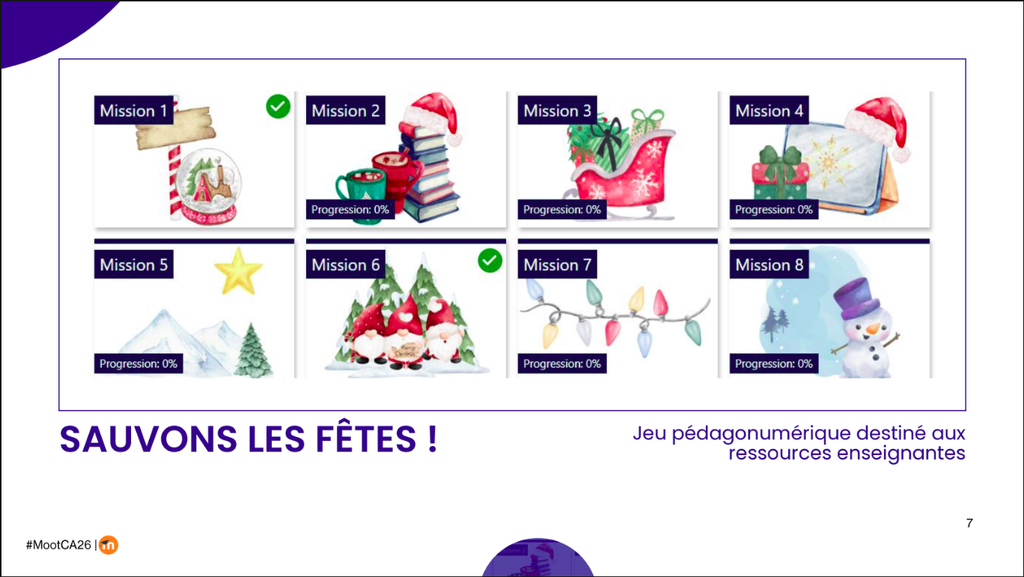
From her presentation, she shared some important considerations for using gamification in online learning and professional development.
- Your learning goals. What are your objectives? What is expected of your learners once they finish their training? While gamification is a great way to make learning more engaging, instructors need to ensure that each tool has a purpose and connects with the learning objectives.
- Your learners’ characteristics and needs. This can be challenging, as everyone has their own learning styles. How engaged are your learners? How much time is expected of them to finish their modules and assessments?
- Your learners’ access to materials and technological resources: How will your learners access their learning materials? Are they provided on paper? Are they only available online? Is content available offline? How tech-savvy are your learners? These can affect how motivated your learners are to learn, whether or not they can access their learning materials.
- Your assessments: How will you assess your learners’ progress? How can you identify if your learners met the course objectives?
These can all affect how you set up your learning scenarios, and which tools you’d want to use for your Moodle.
EXPERT TIP: Start small. Gamifying your course content can be an engaging part of learning, but introducing too many new elements at once can be counterproductive and may distract from the actual content that learners need to learn.
Impacts of gamification in workplace training and professional development:
In Emilie’s presentation, she shared how they used gamification in their Christmas-themed training module. Some of the results included:
- Increased interactions in the month of December, which tends to be a busy time as exams and final grading tend to take place. December showed the highest monthly traffic ever recorded for their Moodle, representing 31% of annual traffic.
- 539% increase in visits to the Moodle site, compared to the previous month of November
Emilie presented further data to showcase her process in using gamification in their Moodle instance for professional development. View her presentation slides from MoodleMoot Canada 2026.
Gamification solutions for your Moodle
Moodle is meant to be extended. Whether you’re teaching in schools, universities, or corporate training, gamification can make your Moodle courses more engaging and effective.
If you want to explore how gamification in your Moodle LMS can help you implement your learning strategies, our experts at Catalyst can help. At Catalyst, our team will work with yours to understand your learners’ unique needs and find the best solution to enhance your learners’ learning experience.
Get in touch with our team today!