
In IT, the term ‘Enterprise’ translates as hardware and software designed to meet the demands of a large organisation. In contrast to small entities, an enterprise has greater requirements for availability, compatibility / integration, reliability, scalability, performance and security, among other things. So what is an Enterprise Learning Management System (LMS)?
LMS technology has evolved over the last few decades, from the early days of basic scheduling and content delivery to today’s option of a fully integrated platform that services the professional and academic needs of users. Beyond learning, an LMS can act as the core technology platform that integrates many other technology systems together, such as enrolment platforms, course management systems, identity and access management systems, and certification management platforms. It is also an integral component of predicting student success.
What makes an LMS Enterprise-Ready?
The key elements
Fundamentally, there are two different elements that make your LMS ‘Enterprise-Ready’. First is the resilience of your platform, that is its availability, reliability, security and overall performance that scales. This is a pre-requisite to being considered Enterprise. Second, there the consideration of compatibility and integration. This element is more complex and tends to be unique to each organisation, depending on the technologies involved and the business goals that need to be achieved.
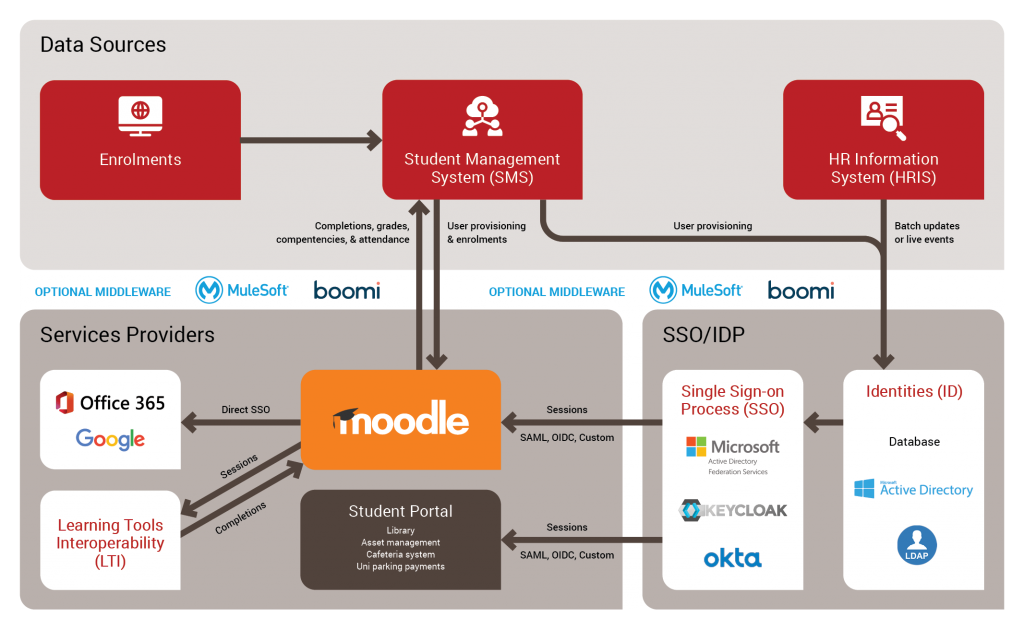
Generally speaking, aside from mapping the course content for your user community, you should be considering mapping workflows for areas such as user provisioning, payment systems integration, enrolments, course development tools integration for publishing new material, resource scheduling for teachers and facilitators, and the information artefacts associated with each workflow.
A fully integrated LMS will handle the delivery and management of examinations and certificate issuance, student records management and course material provisioning. A truly Enterprise LMS will also support a comprehensive administration capability, one that supports the ongoing provision of effective services to the business, even as requirements change.
Choosing the best fit LMS for your organisation
With all the demands of an Enterprise LMS, you’ll need to map your requirements to the available vendor platforms on the market.
Many of the platforms today are designed to support complex administration and management requirements and provide built-in capabilities to manage extensive learning syllabi like those associated with a university. The challenge is, the LMS market consists of well over 500 solutions. Tying your requirements to the right vendors can be complex, time-consuming and downright confusing.

When reviewing vendors, factors such as cost and associated licensing models, along with available support models are vitally important to understand before you commit to a solution. As you might expect, the broader the set of requirements you have, the more expensive a commercial vendor’s platform will become.
Another key factor is how a platform supports modern delivery models for learning, since considerations of how different user communities engage with learning content should be front of mind for your solution architects. For example, microlearning solutions such as the platform provided by EdApp, are great for modernising mobile delivery methods for your course material. However, you need to overlay this with your academic needs, for example multinational course delivery across your university user base.
Total cost of ownership
Calculating your financial commitment to a technology is key, not many organisations have an uncapped budget. Look at the end-to-end costs of running a platform, not just the price of the platform itself.
Total cost of ownership (TCO) for software is usually calculated by including the up-front costs of the software itself and licensing for end users. Then there’s the costs associated with administration, complex workflow design and implementation, support from vendors or contractors, and how quickly the solution can service your overall business needs (time to value).
Some vendor solutions are expensive to purchase, pushing up your capital investment, but ongoing support is included along with implementation assistance. This may be a good option for keeping ongoing operational costs low. However, be aware that you may get a standard suite of functionality. Other solutions can flip this model, with no platform costs (for example open-source software platforms like Moodle). However, they do require design and build costs, as well as ongoing support to support and maintain it. The key to success here is choosing the right technology services partner to work with.
Architecture for evolving delivery models
Since the COVID-19 Pandemic began, many organisations have changed the way learning and development works. Universities and colleges have led the transition to new delivery models, either full e-learning or hybrid learning, with a blend of live online and e-learning modules used to achieve a single outcome.

The rapid use case change in LMSs has meant the technology has been pressure tested to scale. There has been a step change from managing just a handful of students interacting remotely, to an entire user base needing to access material using the different delivery models.